
We visited China's most famous and popular tourist sites, the Terracotta Warriors (Bīngmǎ Yǒng, 兵马俑). This incredible collection of well over 6,000 figures was accidentally unearthed by a group of peasants trying to dig a well in 1974. Instead of water, they found a 2,000-year-old statue of a warrior made to protect the Tomb of the Emperor Qin Shi Huang, the founder of the Qin Dynasty.
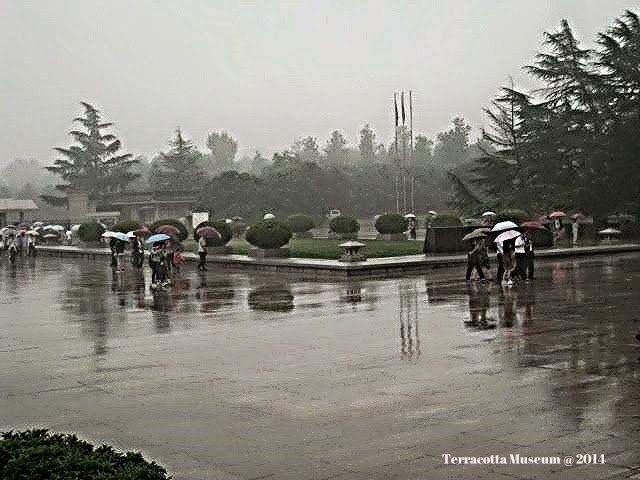
What a day! There was a great down pour since early morning. The main road leading to the mausoleum was half an-hour walk as buses are not allowed in. Imagine the condition of your hands will be like, with temperature hovered around 10-12C with one hand holding an umbrella and another a camera. Besides we were also fighting the mainland mob, pushing and shoving, as a 3-day holiday was declared due to the autumn festival.
What a day! There was a great down pour since early morning. The main road leading to the mausoleum was half an-hour walk as buses are not allowed in. Imagine the condition of your hands will be like, with temperature hovered around 10-12C with one hand holding an umbrella and another a camera. Besides we were also fighting the mainland mob, pushing and shoving, as a 3-day holiday was declared due to the autumn festival.


The terracotta army is ranked among the world's top archaeological finds and the mausoleum of the First Qin Emperor were declared a UNESCO World Heritage Site in 1987.
An amazing site after entering the pit. We were forced to push our way through the massive bodies in order to view and snap photos.
To date, four pits have been discovered, with Pit 1 housing the main force of the army. Three underground pits totally cover an area of 23,000 square meters, housing an estimated 8,000 life-sized pottery warriors and horses. The three pits were built in similar basic construction and vary in size and shape. The fourth pit is yet to be excavated, will be a long time as they want to preserve for the future generations.
An amazing site after entering the pit. We were forced to push our way through the massive bodies in order to view and snap photos.
To date, four pits have been discovered, with Pit 1 housing the main force of the army. Three underground pits totally cover an area of 23,000 square meters, housing an estimated 8,000 life-sized pottery warriors and horses. The three pits were built in similar basic construction and vary in size and shape. The fourth pit is yet to be excavated, will be a long time as they want to preserve for the future generations.


The underground pits that have been unearthed are covered by modern hangar-like structures to protect the treasures. The warriors stand in formation, row after row, it's an amazing sight. Standing in ranks as if awaiting a battle, each warrior is unique, featuring different facial expressions and sculpted hands which held real weapons (many of which survive today, albeit in decayed form).


A second pit inside the museum demonstrates how they appeared when they were found: some stand upright, buried to their shoulders in soil, while others lie toppled on their backs, alongside fallen and cracked clay horses. Every piece of the sculptures is charming.
Time and exposure to oxygen have reduced the statues to a slate gray. In addition to the warriors, a number or exquisitely crafted horses stand ready, once hitched to war chariots that have long since turned to dust.


Today portions of the site are sealed off from the public for controlled excavation intended to better preserve the original colors of the painted figures. Also on site are relics from the nearby Emperor Qin Shi Huang's Tomb, which the terracotta army guarded undisturbed for so many centuries.


Original weapons carried by the Terracotta Warriors and crafted of metal have been found in the pits but for the most part have all disintegrated and the only testament to the weapons that remains is the position of the soldiers' hands indicating that they were carrying some sort of tool: crossbows, spears, swords, battle-axes, etc.
After the visit to the pits, we dropped by the museum store and look for the old man signing books, as was told that the man Yang Zhi Fa, the only one of the farmers that discovered the Terracotta warriors still alive today. He is sort of a "mini-celebrity" and likes to come around and sign books.
Digging continues in the area near Mount Li. More and more soldiers, chariots, horses, and weapons are being found. Visitors to China can see the terracotta army in three special museums built above the site.


